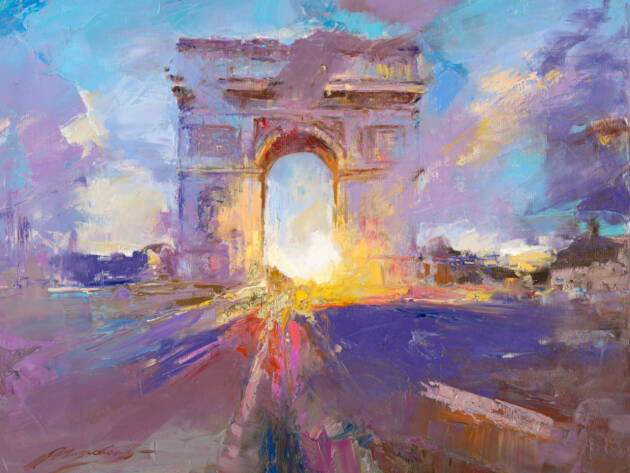
The light is leaving. That is the moment. Not the hard brightness of a Paris afternoon, and not the deep dark of night, but the narrow hour in between, when the sky slips from blue to gold to a violet so soft it almost looks like sleep. A street lamp flickers on above a bistro in the 6th arrondissement. The brass fittings of a café door catch the last of the sun and hold it for a few seconds before the colour fades. The pavement is still damp from an afternoon shower, and the gold pools there, refusing to let go. This is the hour that most people walk straight through on their way home. It is also the hour that Sergei Moskalev has spent a lifetime learning to paint.
Twilight cityscape paintings are not simply a record of how a city looks at a certain time of day. They are paintings about transformation, about the way light works through the air and turns an ordinary street into something you want to hold onto as it disappears. When Sergei stands in front of a canvas with a palette knife in his hand, he is not copying a scene. He is translating a feeling, the particular warmth and quiet that settles over Paris as the day gives way to evening.
Key Takeaways
- Twilight cityscape paintings capture the fleeting hour between day and night, when a city reveals its most emotional, atmospheric self.
- Sergei Moskalev builds his surfaces with a palette knife, layering thick, textured paint that catches light the way wet cobblestones do.
- The magic hour offers a rare palette of warm gold and amber against cool blue and violet, colours that should clash yet somehow sing together.
- In these works light is the true subject, not the buildings or the landmarks, but the way light moves through the air and shapes everything it touches.
- Twilight paintings resonate because they hold an emotional truth rather than a photographic one, making the scene feel personal to whoever stands before it.
The Painter Behind the Twilight
Sergei Moskalev was born in 1970 in Penza, Russia, where his love of light and colour first took shape. He trained at the Penza Art Studio and College under respected masters such as V. Filatov, L. Klevitsky, and B. Borisov, absorbing the classical foundations of drawing, tone, and composition that still anchor his work today. Those early years taught him that a painting is about more than technical skill. It is about having something to say and finding the courage to say it in paint.
In 1992 Sergei became a member of the UNESCO International Federation of Artists, and over the years that followed he exhibited across France and Spain, building a reputation as a painter who could hold something quiet and true about a place on a single canvas. Through all of it, Paris remained his central subject, not the Paris of postcards and crowded plazas, but the living, breathing city that reveals itself in the softer hours.
What Makes a Twilight Cityscape Different
Daylight paintings are clear and confident. Night paintings are bold and dramatic. Twilight paintings live in contradiction, and that is exactly where their power comes from. They are restful and alert at the same time, both a little mournful and quietly joyful. Stand in front of a good twilight cityscape and you are placed between two worlds. The street is still recognisable, you know roughly where you are, yet the scene is dissolving into something dreamlike that belongs more to memory than to geography.
Twilight also does something remarkable to colour. The warm golds and oranges of the fading sun meet the cool blues and purples of the approaching night. By the rules of colour theory these tones should fight one another. Instead they blend into something almost liquid, so that the air itself seems to carry weight and warmth. The buildings stop feeling separate from the sky and begin to melt into it. This is the effect Sergei chases, over and over, in his twilight cityscape paintings.
The Palette Knife and the Language of Light
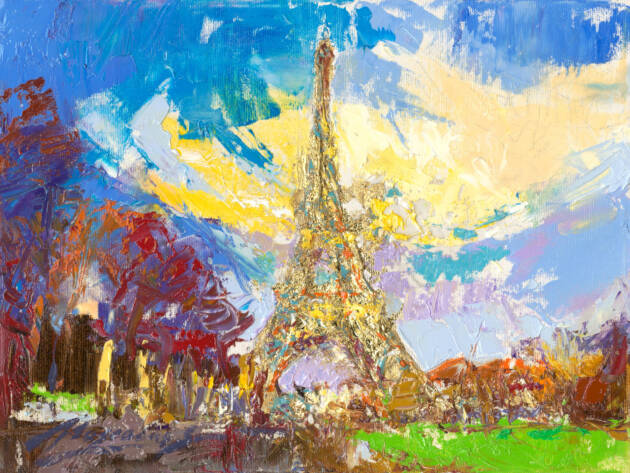
The palette knife is central to how Sergei paints the magic hour. Unlike a brush, which lays colour flat, the knife allows him to build thick, sculptural layers of paint, an impasto surface with real depth. Each stroke stands slightly proud of the canvas and casts its own tiny shadow, so that the painting itself catches and reflects light much as a rain-soaked street does at dusk. The result is a surface that seems to breathe. These are not flat images printed from a photograph. They are living conversations between pigment, light, and memory.
Layer upon layer, the technique creates the illusion that light is actually moving across the canvas. When you stand close, you are not simply looking at a picture of a city at twilight. You are looking at light itself, gathered up and held still for a moment longer than it ever lasts in the real world.
My Love Letter to Paris
Many of these twilight works belong to Sergei’s ongoing series, My Love Letter to Paris. The collection is a heartfelt tribute to the city that has shaped his vision, and the twilight scenes sit at its emotional heart. Rather than famous monuments, they tend to focus on intimate human moments: a solitary figure at a café table watching the light change, a slow walk across a bridge with no hurry to reach the other side, the gold of a street lamp falling across a stranger’s shoulders.
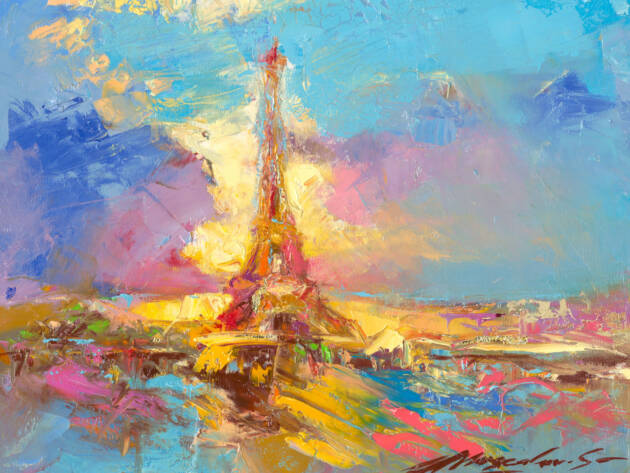
The monuments appear too: in My Love Letter to Paris 007 the Eiffel Tower glows beneath a sky of blue, purple and pink, while in My Love Letter to Paris 005 the same tower shimmers in gold leaf against a brilliant blue sky. In each, the city is recognisable and yet transformed, held in that tender window when Paris stops performing and simply becomes itself.
Bringing a Twilight Cityscape Into Your Space
A twilight cityscape painting brings a particular kind of warmth into a room. The golden tones feel welcoming in a living room, softening the light and drawing the eye, while the quiet, contemplative mood suits a bedroom or a reading corner where you want a sense of calm. Because each piece is an original oil on canvas built with the palette knife, the texture shifts as the daylight in your own home moves across it, so the painting never looks quite the same twice.
For collectors, these works offer more than decoration. An original twilight cityscape carries the hand of the artist in every ridge of paint, a one-of-a-kind object that holds its presence on a wall for decades. It is a way of keeping the magic hour close, long after the real light has faded outside your window.
Step Into the Magic Hour
Twilight is generous to those who slow down long enough to notice it. Sergei Moskalev’s twilight cityscape paintings are an invitation to do exactly that, to stand at the edge of day and evening and feel the city glow from within. To explore the full range of these atmospheric Paris scenes, visit the My Love Letter to Paris collection, or learn more about the artist and the journey that led him to the magic hour.
Ready to bring a piece of Paris home? Get in touch to inquire about a painting or commission a piece.