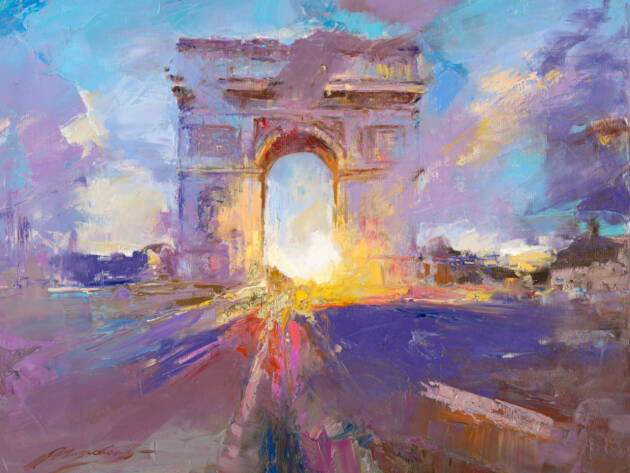
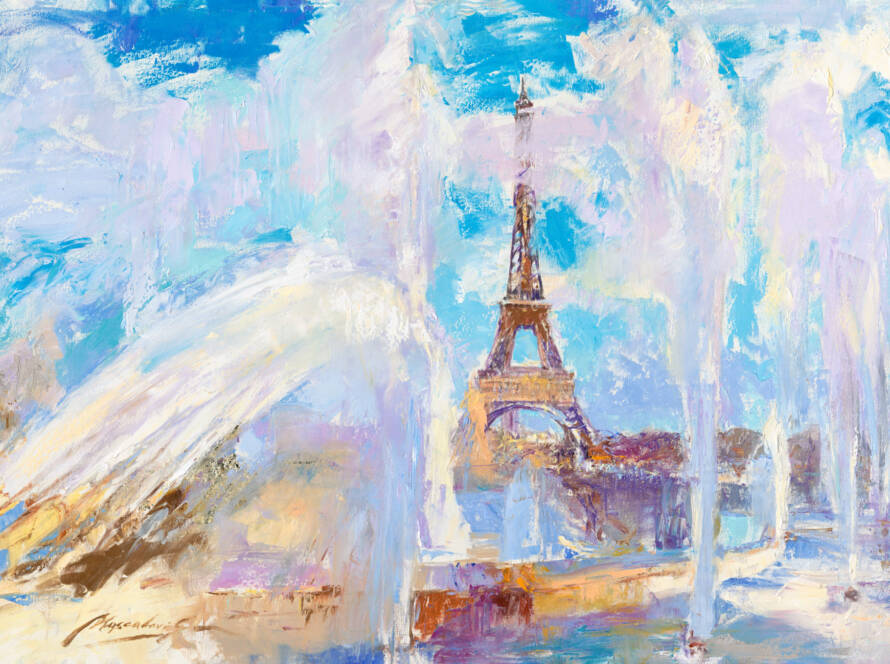
The first time you stand before a Sergei Moskalev painting, you do not think about art history or technique. You think about stepping off a side street near the Marais on a November evening, when the air carries the smell of espresso from a corner cafe and wet cobblestones reflect the amber glow of streetlamps. His palette knife paintings do not hang on a wall so much as they invite you inside a moment you recognize but cannot quite name. That is the power of European romantic impressionism art in his hands: it does not document Paris. It remembers it.
Moskalev works in a tradition that began nearly 150 years ago when Monet painted haystacks in different light and Renoir captured the soft chaos of a riverside dance. But his paintings are not dusty museum exercises. When he loads his palette knife and drags golden paint across canvas, building thick, textured layers that catch light the way wet pavement does after rain, he is doing something more immediate. He is recording what light does to a place when nobody is watching. He is showing you the instant when day surrenders to evening and a cafe becomes the warmest thing in the world.
The paintings in his My Love Letter to Paris collection sit somewhere between the classic impressionist dream and something more personal. These are not idealized Paris. These are his Paris. The one where the Eiffel Tower dissolves into dusk not as a monument but as a memory. Where a street corner holds more feeling than any postcard could suggest. Where rain does not ruin a moment; it deepens it, turning sidewalks into mirrors of light and shadow.
When people talk about European romantic impressionism art, they often mean paintings made for escape. But Moskalev's work does something different. His textured brushwork and luminous golden tones do not ask you to leave the world. They ask you to look at it more carefully. They ask you to notice how the light slants through a cafe window, how buildings lean against each other like old friends, how a city at twilight becomes something between solid and dream. Gold for me represents the paint that has always symbolized the sun, Moskalev says. I aspire to have more rays of sunlight in my paintings. That philosophy runs through everything he creates. Light is not decoration in his work. Light is the subject. Everything else follows where light leads.
The brushwork in paintings like [My Love Letter to Paris 003](https://sergeimoskalev.com/product/my-love-letter-to-paris-003/) shows this clearly. The canvas does not sit flat behind glass. The impasto, the thick layered paint, creates actual shadow and dimension. You can see where his palette knife has pulled the pigment across the surface, where colors sit beside each other without blending, where the light source seems to come from within the paint itself. This is not decoration. This is the bones of impressionism, built up and made real through his hands.
For a painter working in the 21st century, choosing European romantic impressionism art as his language is not nostalgia. It is commitment. It means refusing to paint what the eye sees and instead painting what the heart feels when light touches a place we love. Moskalev's work proves that this approach remains vital. The technique is centuries old. The feeling is immediate. The paintings speak across time because they speak about time: about how light changes everything, how a moment can be held on canvas, how a city can become a conversation between the painter and his memory.
KEY TAKEAWAYS
- European romantic impressionism art tradition reaches its contemporary expression through Sergei Moskalev's palette knife technique and layered, textured paintings
- His My Love Letter to Paris collection captures atmospheric Paris scenes using thick impasto and luminous golden tones rather than idealized documentation
- Light is the primary subject in his work, not decoration; thick textured brushwork creates actual dimension and shadow on canvas
- The paintings build intimate emotional connection to Paris through concrete sensory details like cafe warmth, rain-slicked streets, and twilight moments
- Moskalev's commitment to impressionist technique proves the approach remains contemporary and vital for capturing how light transforms a place
THE ARTIST BEHIND THE CANVAS
FROM PENZA TO PARIS: A PAINTER'S JOURNEY
Sergei Moskalev was born in 1970 in Penza, Russia, a city with its own quiet light and riverbanks that taught him how to see. He studied under masters like V. Filatov, L. Klevitsky, and B. Borisov at the Penza Art Studio and College, where he learned the foundation that would carry him through decades of painting. That training was classical, rigorous, and rooted in understanding how paint moves and how light behaves on a surface. These are not skills you learn from watching videos. These are skills that come from standing in a studio for years, mixing pigment, testing canvas, understanding why one approach to the palette knife works and another fails.
In 1992, Moskalev became a member of the UNESCO International Federation of Artists, a recognition that his work had moved beyond the academy into the wider conversation about what painting could be. He exhibited in galleries across France and Spain, spending time in the places that called to him. But it was Paris that held him. Not Paris the icon or Paris the tourist destination, but Paris the everyday living city where the light changes the feeling of the same street six times a day. Through the years his heart remained oriented toward European romantic impressionism art and specifically toward the light of Paris as it filtered through rain, through evening, through the windows of small cafes.
This journey from Penza to Paris matters because it shaped how he paints. He comes from a tradition that values craftsmanship, but he works with the freedom of someone who has lived in multiple places and understood that home is not always geographic. For Moskalev, Paris became the place where all his training could speak at once: the classical precision he learned in Penza, the impressionist tradition he discovered in Europe, and the personal vision he developed by living and watching and remembering.
THE PALETTE KNIFE TECHNIQUE: BUILDING LIGHT ON CANVAS
The palette knife is not a brush. A brush asks for a certain kind of gesture, a kind of dance. A palette knife is more like dialogue. You load it with thick paint, drag it across canvas, and the paint responds in ways you cannot fully control. That unpredictability is the entire point. It is also why most artists do not use this technique for complex scenes. It is harder. It requires more skill.
Moskalev uses the palette knife the way a sculptor uses stone. He is not trying to hide the tool marks. He is showing them. When you stand in front of [My Love Letter to Paris 001](https://sergeimoskalev.com/product/my-love-letter-to-paris-001/), a large golden twilight cafe scene, you can see every decision. You can see where he decided the paint needed to be thicker to catch more light, where he scraped back to reveal a layer beneath, where two colors sit beside each other without merging because they need to vibrate against each other. The surface is not smooth. The surface is alive.
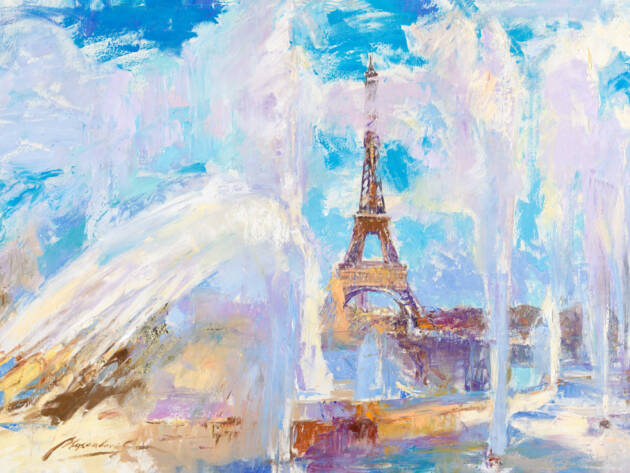
This technique places him squarely in the tradition of European romantic impressionism art, but with a contemporary hand. Monet and Renoir built their paintings with brushes and many small strokes. Moskalev builds his with the palette knife and fewer, more deliberate gestures. The effect is more sculptural, more dimensional. Light does not just sit on the surface. Light gets trapped in the texture. It bounces. It comes forward. It asks your eye to move across the painting rather than settle into it.
The textured surfaces he creates mean the paintings change as you move. A section that looks golden from one angle might shift toward amber from another. This is not an accident. This is European romantic impressionism art understood as a practice of light, not as a style. Light is not constant. Neither should the painting be.
MY LOVE LETTER TO PARIS: CAPTURING THE CITY OF LIGHT
The My Love Letter to Paris collection began as a simple decision: to stop trying to paint the Paris that exists in photographs and postcards, and instead to paint the Paris that exists in his memory and feeling. The series includes paintings of different sizes, from the small intimate [My Love Letter to Paris 004](https://sergeimoskalev.com/product/my-love-letter-to-paris-004/), an intimate cafe corner painting at 50x30cm, to the larger expansive views that hold the full atmosphere of evening in the city.
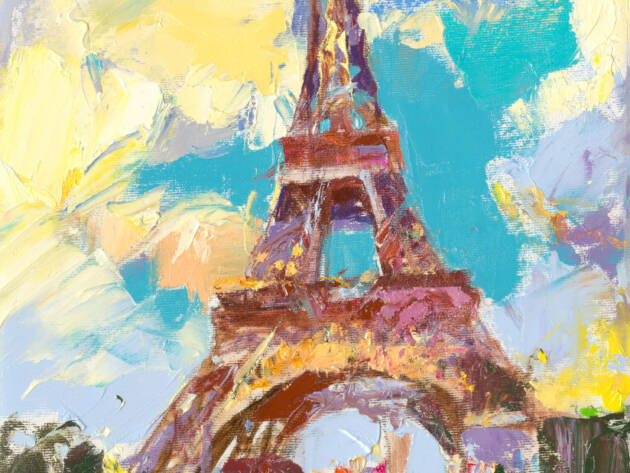
What holds them together is not subject matter. It is approach. Each painting in the collection begins with light. Moskalev decides what time of day, what weather condition, what quality of illumination he wants to capture. Then he builds the scene around it. A cafe becomes interesting not because of its architecture but because of how lamplight spills onto the pavement outside. A street becomes worth painting because rain has turned it into a mirror. A building becomes important because twilight makes it part of the sky rather than separate from it.
This is the essential gesture of European romantic impressionism art as Moskalev practices it. The painting is not about the thing. The painting is about what light does to the thing. It is about that moment of transformation when a familiar place becomes strange and beautiful because the sun is setting or the rain is starting or the evening has just begun. These paintings ask you to remember that moment in your own life. They ask you to recognize that transformation is happening all the time, and that slowing down to notice it is what being alive means.
The Emotional Power of Paris Art
There's something about Paris that makes people feel things deeply. Maybe it's the architecture, or the way the streets wind through centuries of history. Maybe it's the light itself. When you look at European romantic impressionism art, you're not just looking at buildings and streets. You're looking at someone's feelings about a place they love. Sergei Moskalev understands this completely. His work captures the emotional truth of Paris, not just what the city looks like.
His paintings pull you into a moment. They make you stand in that street corner with him. They make you feel the coolness of the evening air, even though you're looking at canvas and paint. That's the magic of European romantic impressionism art done right. It's not about perfect details. It's about the feeling that washes over you when you see the golden light falling across old buildings.
Connecting to European Culture Through Color
Color is the language of emotion in these paintings. Sergei uses colors not because that's what he literally sees, but because that's what the moment feels like. A street in Paris at dusk isn't just gray and white. It's warm amber, soft violet, gentle pink, and always, always that luminous golden light that makes everything feel alive and connected to something bigger.
When you look at a Paris painting from Sergei's collection, you're connecting to something that European painters have been exploring for hundreds of years. The impressionists understood that a moment has a feeling, and that feeling comes through color. They knew that the light in Paris carries emotion. It's not separate from the buildings and people. The light IS the emotion. Sergei continues this tradition, working with palette knife technique to layer colors in ways that feel spontaneous and alive, like the moment itself is still happening.
The blues in his work speak to solitude and reflection. The warm golds speak to hope and beauty. The grays speak to mystery and the weight of history. Together, these colors create a symphony that touches something inside you that everyday life sometimes covers up.
Stories Told Through Atmosphere
European romantic impressionism art is really about storytelling without words. Every painting tells a story about light, about time, about the way a place makes you feel. In Sergei's work, the stories are personal. They're his love letters to Paris, written in color and light.
Think about walking through a European city at different times of day. Early morning, the streets are quiet and fresh. Midday, everything is sharp and clear. Evening, everything softens and glows. The story of that day is written in the light. That's what these paintings capture. They're not trying to show you Paris the way a camera would. They're trying to show you Paris the way your heart remembers it.
A story in these paintings might be about loneliness in a crowd. It might be about finding beauty in old, worn places. It might be about the way golden light can make you feel like you're part of something ancient and beautiful. The atmosphere is the storyteller. The colors and brushwork tell you everything you need to know about what Sergei felt when he stood in that spot, seeing what he saw, understanding what he understood.
The Golden Hour: Paris Bathed in Warm Light
There's a specific time of day that European romantic impressionism art loves more than any other time. It's the golden hour, when the sun is low and everything is bathed in warm, luminous golden tones. In Paris, this is the most beautiful time. The old buildings, the rivers, the streets, the people, all of them glow like they're made of light itself.
Sergei captures this moment over and over because it's when Paris is most honest. It's when all the pretense falls away and you see what's really there: beauty, history, human connection, and the fact that nothing lasts forever. The golden light reminds us that this moment, right now, is all we ever really have. And it's enough. It's more than enough. It's everything.
—
Collecting and Displaying Paris Paintings
Collecting European romantic impressionism art isn't about having the right credentials or knowing the right things to say about art. It's about connecting with work that speaks to you. It's about finding paintings that make you want to stop and look, that make you feel something when you see them. That's where real collecting starts, and that's what makes it meaningful.
When you're thinking about collecting Sergei's Paris paintings, you're thinking about bringing warmth and light into your home. You're thinking about having a daily reminder of beauty, of slow moments, of the way a place and a feeling can become one thing. These aren't paintings you glance at and forget. They're paintings that change how you feel when you look at them.
Choosing the Right Piece for Your Space
The first thing to think about is where the painting will live. What room are you thinking about? What does that room mean to you? A bedroom is about rest and dreams and personal reflection. A living room is about gathering and sharing space with people you care about. A kitchen is about nourishment and morning light. An office is about focus and creativity.
Each room in your home has its own feeling and its own story. The painting you choose should speak to that. If you have a room that feels too cold or too empty, a Paris painting can warm it up. If you have a room where you want to feel calm and thoughtful, Sergei's work can create that space for you.
Think about the light in that room too. Does it get morning light or evening light? Does it get bright afternoon sun or is it softer? A Paris painting will interact with your room's light. It will change throughout the day, just like it does in the paintings themselves. That's part of what makes living with this work so beautiful. It's never quite the same twice.
Evening Cafe Glow: A Centerpiece of Warmth
There's something almost spiritual about a cafe in Paris at evening time. The lights come on inside while the sky is still holding onto the last golden light. People gather around small tables. The windows glow warm and inviting. It's one of the most honest scenes in European culture, a moment where strangers come together in warmth and light.
In My Love Letter to Paris 005, Sergei captures this exact feeling. The cafe windows glow with soft, luminous golden light that seems to spill out onto the street. The colors are warm and inviting, painted with palette knife technique that makes the whole scene feel immediate and alive. You're not looking at a memory. You're looking at the moment as it's happening. There's movement in the brushwork, warmth in every color choice, and a sense of people being drawn together by light and beauty.
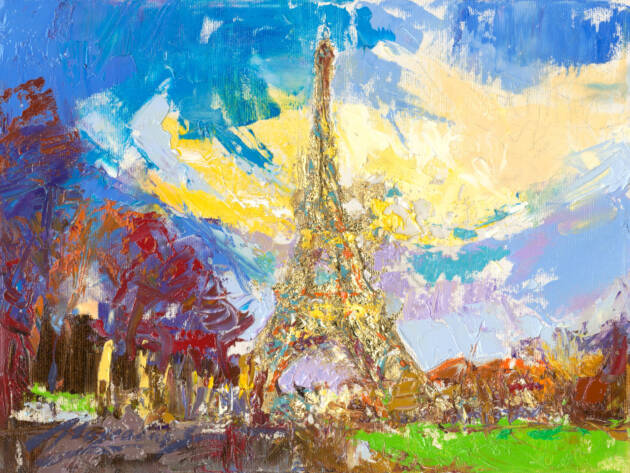
This is the kind of painting that becomes a centerpiece for a room. It's not something that blends into the background. It's something that speaks every time you look at it. It says something true about what it means to be human, to seek light and warmth, to gather with others in beautiful moments. When you display a piece like this, you're not just decorating. You're creating a focal point for warmth and connection.
Placement and Lighting Tips for Impressionist Art
Where you hang a Paris painting matters. You want it somewhere that gets natural light during the day if possible. Impressionist work comes alive in daylight. The colors sing differently in morning light than in afternoon light. The luminous golden tones respond to the light in your room. It's a living relationship between the painting and the space around it.
Avoid hanging it in direct, harsh sunlight. You don't want the paint to fade or the colors to wash out. But soft, indirect light will make these paintings glow. If your room doesn't get much natural light, consider adding a simple picture light above the painting. This helps the colors remain vibrant and creates a subtle emphasis that makes the painting feel special.
The height matters too. The center of the painting should be at eye level when you're standing in the room. This is the most comfortable place for your eye to rest. You want to be able to look at it naturally, without stretching or bending. This creates a conversation between you and the work, something easy and natural and beautiful.
—
Paris Art as a Gift and Keepsake
There are certain kinds of gifts that people keep forever. Gifts that sit in homes and apartments and offices for years and years, becoming part of the fabric of someone's life. A Paris painting from Sergei's collection is that kind of gift. It's meaningful without being heavy. It's beautiful without being pretentious. It's the kind of gift that says something true about the person you're giving it to.
Meaningful Gifts for Art Lovers
If you're shopping for someone who loves art, you already know that not all art gifts land the same way. Some art gifts feel obligatory. Some feel like someone was checking a box. But a Paris painting feels personal. It feels like you understand something about this person, something about what moves them and what makes them feel alive.
European romantic impressionism art speaks a language that art lovers understand. It connects to centuries of tradition. It honors the masters. But it also speaks to modern hearts, modern lives, modern ways of finding beauty in everyday moments. When you give someone a painting from Sergei's My Love Letter to Paris series, you're giving them something that respects their taste while also giving them something that's alive and fresh and new.
Think about what this person loves. Do they love Paris? Do they love light and color? Do they love quiet moments and beauty? Do they appreciate the way art can capture a feeling that words can't quite touch? If the answer is yes to any of these, a Paris painting is perfect. It's saying, "I see you. I understand what you love. I want you to have something beautiful to look at every single day."
Building a Fine Art Collection
Some people come to collecting art slowly, one piece at a time. They don't set out to build a collection. They just find a painting that speaks to them, and they buy it. Then they find another one, and another one. Before long, they have a collection. And they realize that each piece talks to the others, that the paintings together tell a story about who they are and what they love.
Starting a Paris painting collection is an easy way to begin with fine art. These paintings work well with many different styles and aesthetics. They add warmth to any space. They get better as you add more pieces. A single painting is beautiful. Three or four paintings create a conversation. Sergei's My Love Letter to Paris series gives you the chance to build this collection thoughtfully over time.
You don't need to spend a fortune to start. You don't need to understand art history or know the right people. You just need to find a painting that makes you feel something, and then bring it home. Everything else grows from there.
—
Painting Collection Overview
Sergei Moskalev's My Love Letter to Paris series represents years of work and deep connection to one of the world's most beautiful cities. This isn't a single painting or a quick study. This is a full series that explores Paris in different lights, different seasons, different moods. Each painting is numbered, from My Love Letter to Paris 001 through My Love Letter to Paris 010, and each one is a complete statement on its own while also being part of a larger conversation about what Paris means and what it feels like to stand in its streets and see its light.
|
Collection |
Style |
Technique |
Link |
|
Romantic Impressionism |
Palette Knife on Canvas |
||
|
Atmospheric Cityscape |
Palette Knife, Impasto |
||
|
Romantic Landmark |
Palette Knife on Canvas |
||
|
Urban Impressionism |
Palette Knife, Mixed Media |
The series uses palette knife technique throughout, which means Sergei isn't using brushes alone. He's using a palette knife to apply paint directly to canvas. This creates texture, depth, and a sense of movement that feels alive. The paint itself seems to move, seems to have energy. This technique is perfect for European romantic impressionism art because it matches the immediacy of the moment. It feels spontaneous, like Sergei is capturing what he sees before the light changes, before the moment passes.
Each painting in the series explores the relationship between light and place. How does golden light transform a street corner? How does evening light change the way you feel about a building? What happens when rain begins to fall? What does it feel like to stand in Paris when no one else is around? These are the questions that drive the work. The paintings are answers to these questions, written in color and light and luminous golden tones.
—
Featured Highlight
The Eiffel Tower at Twilight: Romance in Every Brushstroke
There are certain images that people associate with Paris, and the Eiffel Tower is the first one. Everyone knows it. Everyone recognizes it. But that doesn't mean it's easy to paint something true about it. Most images of the tower feel like postcards. They feel like they've already been seen a thousand times. What Sergei does is different.
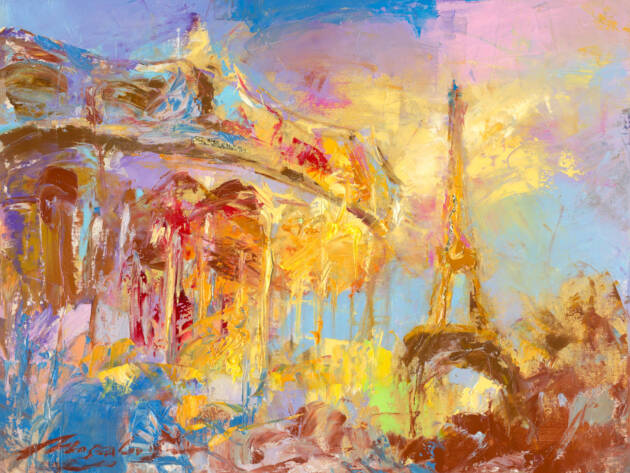
In My Love Letter to Paris 002, the Eiffel Tower appears through evening light. It's not the sharp, clear tower that appears in photographs. It's softer, dreamier, more emotional. The luminous golden light bathes everything. The colors are warm and soft. The palette knife work makes the whole scene feel like it's still moving, still changing, still becoming something beautiful in the moment you're looking at it.

This is what makes Sergei's work special. He takes something everyone knows and finds something true and new inside it. He finds the romance that the tower actually carries if you know how to look for it. He finds the light that makes it a symbol of beauty and hope and the possibility of connection. When you look at this painting, you're not looking at a monument. You're looking at a feeling, captured in color and paint, made permanent so you can hold onto it forever.
European Romantic Impressionism Art: The Golden Heart of Paris Paintings
The Soul of European Romantic Impressionism Art
European romantic impressionism art speaks a language that lives beyond words. It's the whisper of possibility in a brushstroke, the warmth of connection in golden light falling across a Parisian street. Sergei Moskalev understands this language deeply. His work doesn't just show you Paris—it invites you into the emotion of being there, of moving through those beloved streets with your heart open to beauty.
When we talk about European romantic impressionism art, we're talking about something that touches the deepest parts of what makes us human. It's about finding meaning in everyday moments. A lamp glowing softly in the evening. A café where lovers have met for centuries. The way light transforms ordinary stone into something that feels sacred. These aren't grand gestures. They're intimate moments painted with the kind of tenderness that only comes from truly loving a place.
Moskalev's approach to European romantic impressionism art is distinctly his own. He uses the palette knife technique—a method that lets him build color and texture in ways that feel almost sculptural, almost three-dimensional. When light hits these paintings, it moves across the surface in unexpected ways. Golden luminous tones seem to glow from within. The paintings become living things, changing as the light in your room changes. That's the magic of this style. It's not static. It's breathing.
The tradition of European romantic impressionism art comes from a place of deep respect for beauty in simplicity. The Impressionist painters of the past taught us to look closely at light and color, to understand that a water lily or a haystacks or a bridge isn't just an object—it's a feeling, a moment, a chance to connect with something larger than ourselves. Sergei carries this tradition forward, but he makes it his own. His Paris paintings feel contemporary and timeless all at once.
Why Golden Light Matters in European Romantic Impressionism Art
Golden light is the heart of everything Sergei creates. In European romantic impressionism art, light isn't just something you see—it's something you feel. Golden tones have this way of making us feel safe, warm, understood. They remind us of home, of love, of moments when everything felt possible. When Sergei paints golden light touching the edges of Parisian buildings or reflecting in street puddles, he's painting something universal. He's painting the feeling you get when you realize you're exactly where you need to be.
This golden luminous quality is what separates sentimental art from truly meaningful art. Anyone can paint Paris. It's iconic. It's famous. But can you paint the *feeling* of Paris? Can you capture in color and texture what it means to walk those streets and feel your heart expand? That's what European romantic impressionism art is really about. And that's what Sergei does with every single painting.
The palette knife technique he uses amplifies this golden quality. Instead of smooth brushstrokes, the paint sits on the canvas in visible layers. Light catches these layers differently. Shadows dance. Highlights sing. What you see from across the room changes when you move closer. The golden tones seem to shift and breathe. It's like the painting is alive, responding to you, meeting you where you are emotionally.
The Connection Between Light, Beauty, and European Romantic Impressionism Art
European romantic impressionism art teaches us that beauty is everywhere, but you have to train yourself to see it. Sergei does this training for you through his work. He looks at Paris—a city that millions of people walk through every year—and he finds something new in it. Something true. Something that makes you want to pause and really *see* the world around you.
This is the gift of European romantic impressionism art. It's not escapism, even though it can feel like that. It's actually the opposite. It's a reminder to pay attention to the real world, to notice the light on a building at sunset, to appreciate the way people move through public spaces, to find sacred moments in regular life. When you live with a Sergei Moskalev painting, you start looking at your own city differently. You start noticing the golden hour. You start seeing Paris—or your own streets—the way he does.
The beauty of this style is that it's accessible. You don't need an art history degree to feel moved by European romantic impressionism art. You just need a heart that's open to beauty, and maybe a willingness to slow down long enough to notice it.
—
Conclusion
European romantic impressionism art is more than a style or a technique. It's a way of seeing the world with tenderness and hope. Sergei Moskalev has dedicated his practice to capturing that vision, translating the poetry of Paris into paintings that feel both deeply personal and universally resonant. His work reminds us that beauty isn't rare—it's everywhere, waiting in golden light and familiar streets, in moments we pass through every day without fully seeing them.
When you bring one of Sergei's paintings into your home, you're not just adding a piece of art to your walls. You're inviting a conversation about what matters. You're creating a space where beauty is honored, where light is celebrated, and where the romance of everyday life becomes impossible to ignore. His paintings ask you to slow down, to notice, to feel the warmth of connection and possibility that lives in every corner of a city that's been loved by millions.
If you're drawn to European romantic impressionism art, if you've ever felt that pull toward Paris or toward beauty captured in paint and light, we invite you to explore Sergei's work. Visit sergeimoskalev.com to discover his collections, to see how golden luminous tones dance across his canvases, and to find the painting that speaks to your heart. Whether you're a longtime collector or someone just beginning to understand the power of this style, there's something waiting for you there—a piece of beauty, a feeling made permanent, a love letter to light itself.
—
Frequently Asked Questions
What kind of art does Sergei Moskalev create?
Sergei creates impressionistic Paris cityscapes that capture the soul of European romantic impressionism art. He works primarily with the palette knife technique, which allows him to build layers of color and texture that respond to light in dynamic ways. His paintings aren't realistic photographs of Paris—they're emotional interpretations. He's interested in the feeling of being in a place, the way golden light transforms ordinary streets into something luminous and sacred. His work celebrates beauty in simplicity: a café at dusk, a bridge reflecting in water, the warm glow of a lamp in a window. What makes his art distinct is the way it balances impressionistic spontaneity with a deep romantic sensibility. The golden tones and luminous quality of his paintings create an atmosphere that feels both intimate and timeless. If you've ever wanted to capture the essence of a place—not just how it looks, but how it makes you feel—that's what Sergei's work does.
What collections are available?
Sergei's primary collection is My Love Letter to Paris, which includes paintings numbered 001 through 010. Each painting in this series explores a different facet of Parisian beauty through his signature style of impressionistic technique and golden light. My Love Letter to Paris 001 through 010 represent his most developed work in European romantic impressionism art, each one a distinct meditation on light, color, and the feeling of connection. More collections are in development, expanding his exploration of cityscapes and the interplay between architecture, light, and human emotion. The My Love Letter to Paris series is where to start if you're discovering Sergei's work for the first time. These paintings represent his deepest expression of the romantic impressionism art style that defines his practice.
How can I purchase a Sergei Moskalev painting?
Purchasing a Sergei Moskalev painting is straightforward and accessible. Simply visit sergeimoskalev.com to browse his available work, learn more about each piece, and understand the details of ownership. The website showcases his collections, including My Love Letter to Paris paintings, with information about each work's dimensions, pricing, and the story behind it. Sergei makes the process of acquiring fine art simple and transparent. You can explore his paintings at your own pace, read about his technique and inspiration, and make a decision that feels right for you. Whether you're purchasing your first piece of European romantic impressionism art or adding to an existing collection, sergeimoskalev.com is your direct connection to Sergei's work. The website is designed to help you understand not just what you're buying, but why it matters—to help you see the painting as a relationship, not just a transaction.
What makes Paris art a meaningful gift?
Paris art carries layers of meaning that go far beyond decoration. When you give someone a painting of European romantic impressionism art—especially a Sergei Moskalev work—you're giving them more than an image. You're giving them a portal to beauty, a reminder to notice light and connection in their daily life. Paris itself is universally understood as a symbol of romance, culture, and the poetry of human experience. A Paris painting says: I see you as someone who appreciates beauty. I want you to have something that makes you pause, that makes you feel something when you look at it. For people who've visited Paris, it becomes a way to relive those moments. For people who dream of going, it's an invitation to imagine. The golden luminous tones in Sergei's work create an atmosphere of warmth and hope wherever they hang. This makes Paris art particularly meaningful as a gift for milestone moments—anniversaries, retirements, significant birthdays. It's a gift that says: beauty matters, and you matter, and the moments we notice together matter.
Ready to bring a piece of Paris home? Get in touch to inquire about a painting or commission a piece.